Biasing the quantum vacuum to control macroscopic probability distributions

Introduction

In this work, we have harnessed the natural fluctuations in electromagnetic fields, as suggested by quantum field theory, as a controllable source of perfect randomness. Through injecting vacuum-level bias fields into multi-stable optical systems, we've demonstrated this controllable quantum randomness in an optical parametric oscillator. Our work offers valuable insights into quantum dynamics and probabilistic computing and also underlines potential applications in weak field sensing. Our findings highlight the potential for vacuum-level biased optical systems to probe vacuum field fluctuations and temporal profiles of extremely weak electromagnetic pulses.

Rationale

Traditional computers operate deterministically, executing instructions step by step according to predefined rules and algorithms. This means that running the same operation multiple times always yields the same outcome. This deterministic methodology has fueled our digital era, but it has limitations, particularly when attempting to simulate the physical world or optimize complex systems—tasks often inundated with uncertainty and randomness.

This dilemma inspired us to delve into probabilistic computing, which exploits the inherent randomness of certain processes to perform computations. Instead of providing a single "correct" answer, probabilistic systems generate a spectrum of potential outcomes, each accompanied by its probability. This adaptability makes them ideal for simulating physical phenomena and tackling optimization issues where multiple solutions are feasible, and exploring diverse possibilities can lead to optimal solutions.

Despite its potential, the practical implementation of probabilistic computing has been historically hindered by a significant obstacle: the inability to control the probability distributions associated with quantum randomness. This challenge led us to the focus of our recent study.

Results

In this work, we inject a weak laser bias into an optical parametric oscillator — a system that naturally generates random numbers encoded in the phase of the signal — providing a controllable source of biased quantum randomness (see Figure 1). Our work has unveiled that even a bias field on the order of the amplitude of the vacuum fluctuations can exert an influence on these quantum systems. We show that one can manipulate the probabilities linked to the output states of an optical parametric oscillator, thereby establishing the first-ever controllable photonic probabilistic bit (p-bit). Furthermore, our system has exhibited sensitivity to the temporal oscillations of bias field pulses, even far below the single photon level.
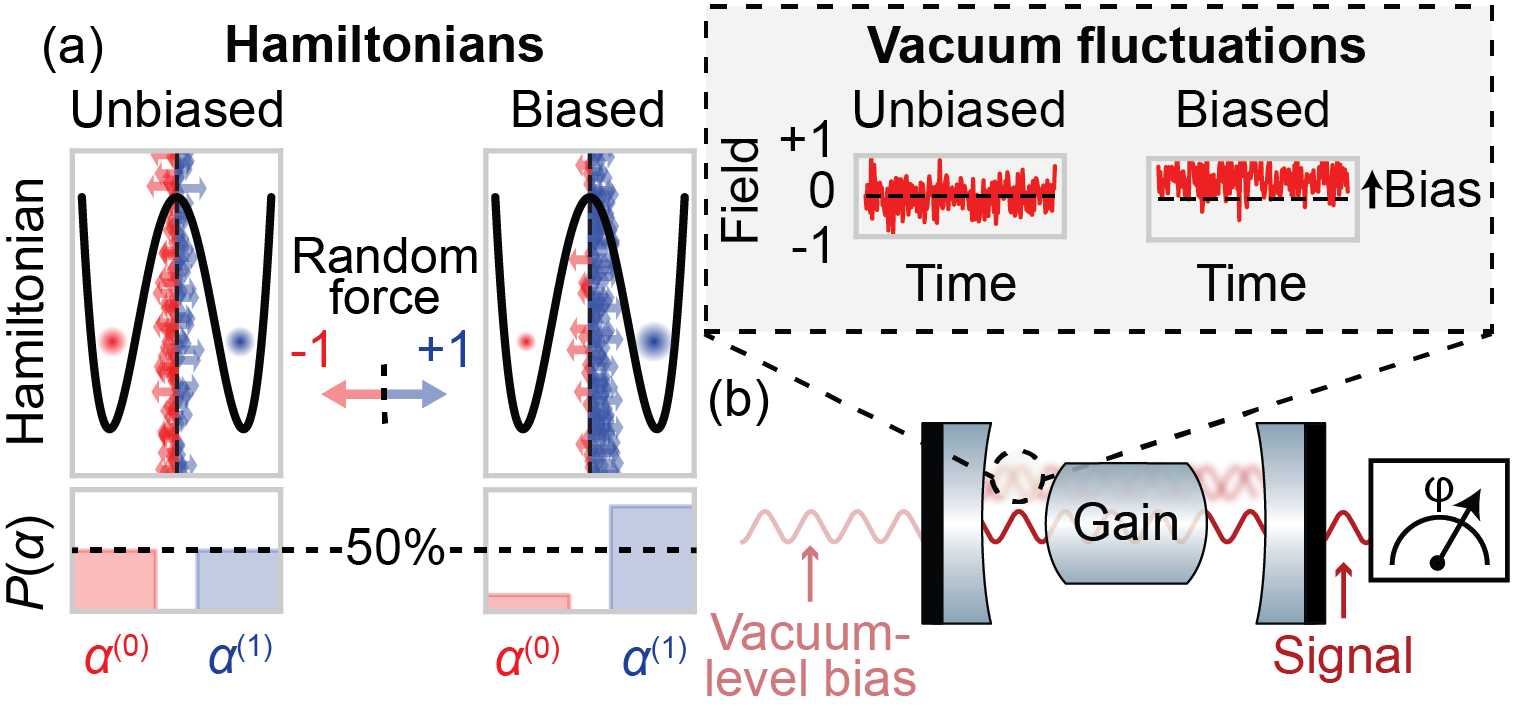
Figure 1

Figure 1 : Tuning the probability distribution of a multi-stable system by biasing vacuum fluctuations. (a, top) Hamiltonians of (left) unbiased and (right) biased systems in the presence of vacuum fluctuations acting as a random force (blue and red arrows). We consider here a bi-stable system for illustration exhibiting isoenergetic local minima. (a, bottom) Corresponding probabilities when performing a phase measurement mapping to the two ground states ɑ0 and ɑ1. (b) Schematic of quantum optical multi-stable system. Gain is generated via nonlinear interaction in the cavity (e.g., via stimulated emission, 𝝌(2), or 𝝌(3) interaction). Inset: A small bias field, whose intensity is commensurate with the vacuum fluctuations, is also injected in the cavity to control the signal's probability distribution.

Applications

We anticipate that photonic p-bits will evolve to produce more than 10,000 bits per second (up to billions per second and beyond), each of which can follow an arbitrary probability distribution. As we continue to advance this technology, we expect to see a wider range of applications in photonic probabilistic computing and higher-rate photonic p-bits.

This breakthrough has broader implications too: by making vacuum fluctuations a controllable element, we're pushing the boundaries of quantum-enhanced probabilistic computing. The exciting prospect of simulating complex dynamics in areas such as combinatorial optimization and lattice quantum chromodynamics simulations might now be within our reach.

To cite this work:

  • Charles Roques-Carmes*, Yannick Salamin*, Jamison Sloan, Seou Choi, Gustavo Velez, Ethan Koskas, Nicholas Rivera, Steven E. Kooi, John D. Joannopoulos, Marin Soljačić, Science 381 (6654) (2023). Correspondence and inquiries should be addressed to chrc@stanford.edu and salamin@mit.edu.
  • Our codes and data are available on GitHub.

Press coverage:

Our work was covered in various press releases and articles:

In English: In French: In Spanish: