Variational optical processing
Impact statement
The rapid growth of machine learning, optimization, and data-intensive computation has placed increasing demands on hardware efficiency, scalability, and energy consumption. As electronic computing approaches fundamental limits, photonics offers an attractive alternative by leveraging intrinsic parallelism, high bandwidth, low latency, and passive signal propagation. Beyond classical interconnects, optical hardware can directly implement mathematical operations relevant to machine learning, optimization, and inference.
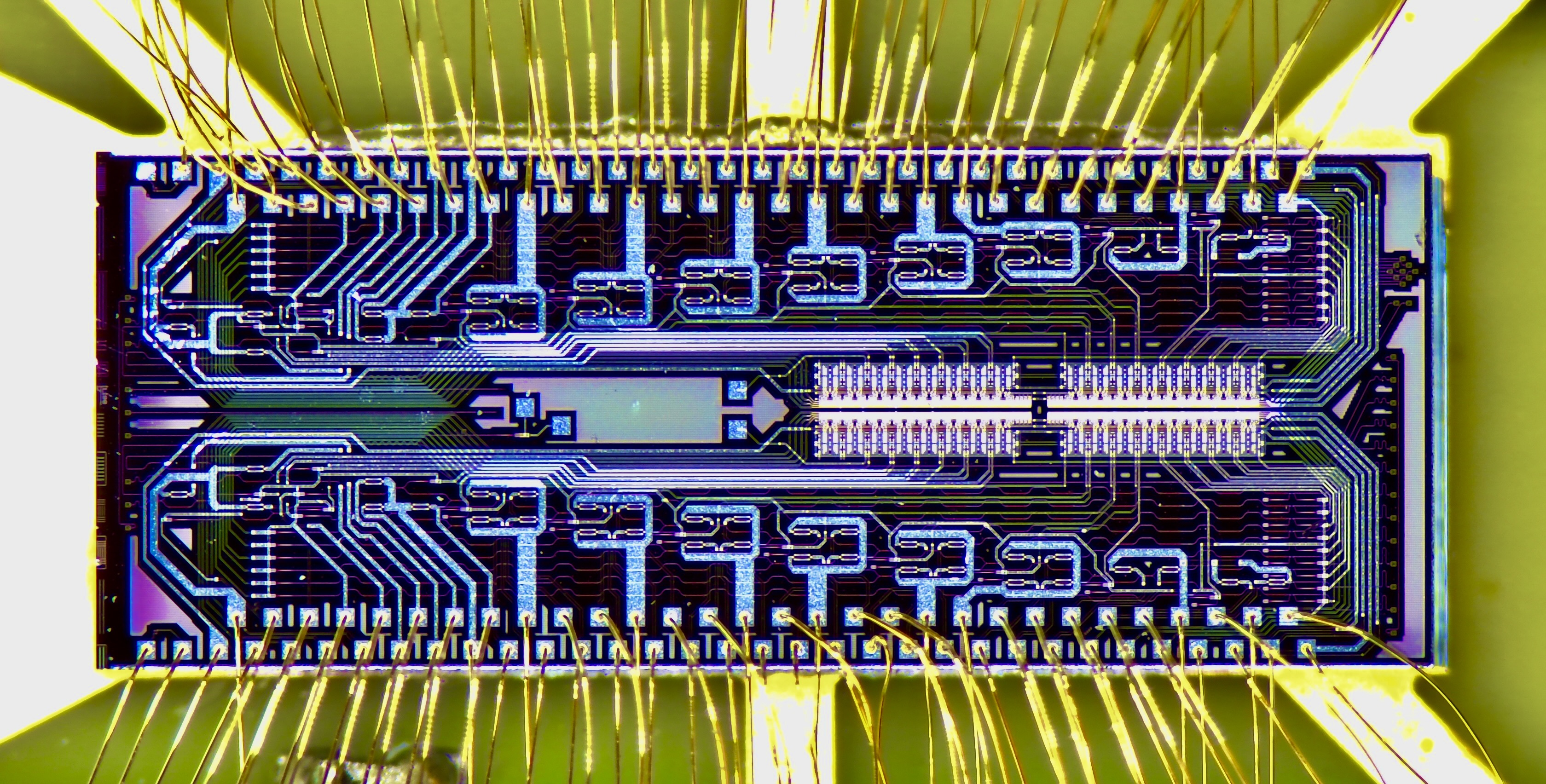
One direction that our research leverages is variational optical processing: a paradigm in which programmable and self-configuring photonic systems learn to perform computational tasks by directly optimizing physical measurements. Rather than emulating digital logic, these systems exploit the physics of wave interference, multimode propagation, and optical correlations to discover problem-specific representations and algorithms. This approach applies across classical and quantum regimes, including continuous-variable quantum optics and multimode squeezed light.
By combining reconfigurable photonic architectures with variational optimization, electronic feedback, and photonic circuit design, we aim to develop scalable optical processors that can efficiently solve hard optimization problems, accelerate learning tasks, and extract structure from high-dimensional optical fields—often with resource requirements that scale favorably compared to conventional architectures.
Research questions
- How can photonic architectures be designed to efficiently accelerate computationally hard tasks, including NP-hard optimization problems and machine learning tasks?
- What classes of algorithms are naturally suited to optical hardware, and how should algorithms be reformulated to leverage physical constraints and resources such as interference, loss, and noise?
- Can self-configuring and variational photonic networks automatically learn optimal modal representations of high-dimensional light fields, including spatial, spectral, and temporal modes?
- How can variational optimization driven by physical measurements (e.g., homodyne detection) reduce circuit complexity and enable scalable processing of multimode classical and quantum optical states?
- What are the ultimate scaling limits—in footprint, control complexity, and energy—of variational optical processors implemented in integrated photonics and synthetic dimensions?
Selected publications
- P.-A. Mor!*, A. R. Kroo*, C. G. Valdez, M. Šimić, A. Karnieli, G. Cavicchioli, Z. Sun, V. Grimaldi, S. Fan, O. Solgaard, D. A. B. Miller, C. Roques-Carmes†, Automatic on-chip separation of partially coherent light into its mutually incoherent components, Nature Photonics, in press (2026) — Covered in the press including Stanford Report, ISTA news, Phys.org, etc.. (Link to article) (Link to preprint)
- C. G Valdez†, A. R. Kroo, M. Vlk, C. Roques-Carmes, S. Fan, D.A.B. Miller, and O. Solgaard, Programmable Optical Filters Based on Feed-Forward Photonic Meshes, Light: Science & Applications, 1, 15, 309 (2026) — Covered by associated News and Views article. (Link to article) (Link to preprint)
- A. Karnieli*†, P.-A. Mor!*†, C. Roques-Carmes*†, E. Lustig, J. Sloan, J. Vučković, D.A.B. Miller, and S. Fan, Variational processing of multimode squeezed light, PRX Quantum, 7, 020311 (2026) (Link to preprint)
- D. A. B. Miller†, C. Roques-Carmes, C. G. Valdez, A. R. Kroo, M. Vlk, S. Fan, and O. Solgaard, Universal programmable self-configuring optical filter, Optica, 9, 12, 1417-1426 (2025) (Link to article) (Link to preprint)
- C. Roques-Carmes*†, A. Karnieli*†, D. A. B. Miller, and S. Fan†, Automated modal analysis of entanglement with bipartite self-configuring optics, ACS Photonics, 6, 12, 3285-3294 (2025) (Link to article) (Link to preprint)
- S. Hua*, E. Divita*, S. Yu, B. Peng†, C. Roques-Carmes, Z. Su, Z. Chen, Y. Bai, J. Zou, Y. Zhu, Y. Xu, C.-K. Lu, Y. Di, H. Chen, L. Jiang, L. Wang, S. Zhang, L. Ou, C. Zhang, J. Chen, Z. Xue, W. Zhang, H. Zhu, W. Kuang, H. Meng†, M. Steinman, Y. Shen†, A highly-integrated large-scale photonic accelerator with an ultra-low latency, Nature, 640, 361-367 (2025) — Covered in the press including Nature News and Views article, ScienceNews, etc.. (Link to article)
- C. Roques-Carmes†, and S. Fan†, In situ training of on-chip neural networks, arXiv preprint, arXiv:2501.07917 (2025) (Link to preprint)
- C. Roques-Carmes†, S. Fan, and D. A. B. Miller, Measuring, processing, and generating partially coherent light with self-configuring optics, Light: Science & Applications, 260, 13 (2024) (Link to article) (Link to preprint)
- M. Prabhu*†, C. Roques-Carmes*†, Y. Shen*†, N. Harris, L. Jing, J. Carolan, R. Hamerly, T. Baehr-Jones, M. Hochberg, V. Čeperić, John D. Joannopoulos, D. Englund, and M. Soljačić, Accelerating recurrent Ising machines in photonic integrated circuits, Optica, 5, 7, 551-558 (2020) (Link to article) (Link to preprint)
- C. Roques-Carmes†, Y. Shen†, C. Zanoci, M. Prabhu, F. Atieh, L. Jing, T. Dubček, C. Mao, M. Johnson, V. Čeperić, John D. Joannopoulos, D. Englund, and M. Soljačić, Heuristic recurrent algorithms for photonic Ising machines, Nature Communications, 249, 11 (2020) (Link to article) (Link to preprint)