Nanophotonics for integrated nuclear clocks
Impact statement
Optical atomic clocks are today’s most precise time and frequency standards, with crucial applications in global navigation, communication, and quantum metrology. Still, their size and complexity mostly confine them to specialized laboratories, while existing chip-scale atomic clocks are far below in performance compared to table-top systems. A solid-state frequency reference can overcome these constraints, enabling compact and robust time standards deployable far beyond the laboratory.
What if instead of an atomic transition between electronic levels we leverage a nuclear one? Intuitively, the nucleus is much smaller in size and thus less sensitive to external perturbations, which promises to enhance the clock’s performance. Although the typical energy ranges of nuclear excitations lie in the MeV-keV domain and require X-ray sources, nature has gifted us with the Th-229 isotope which has an exceptionally low energy of around 8 eV (or 148 nm wavelength).
Recent experimental breakthroughs on the observation and laser-excitation of the Th-229 nucleus open up a path toward optical nuclear clocks. Taking it a step further - what if we use nanophotonics to enhance light-nucleus interaction and push the clock’s performance and scalability even further while reducing the necessary amount of Th-229?
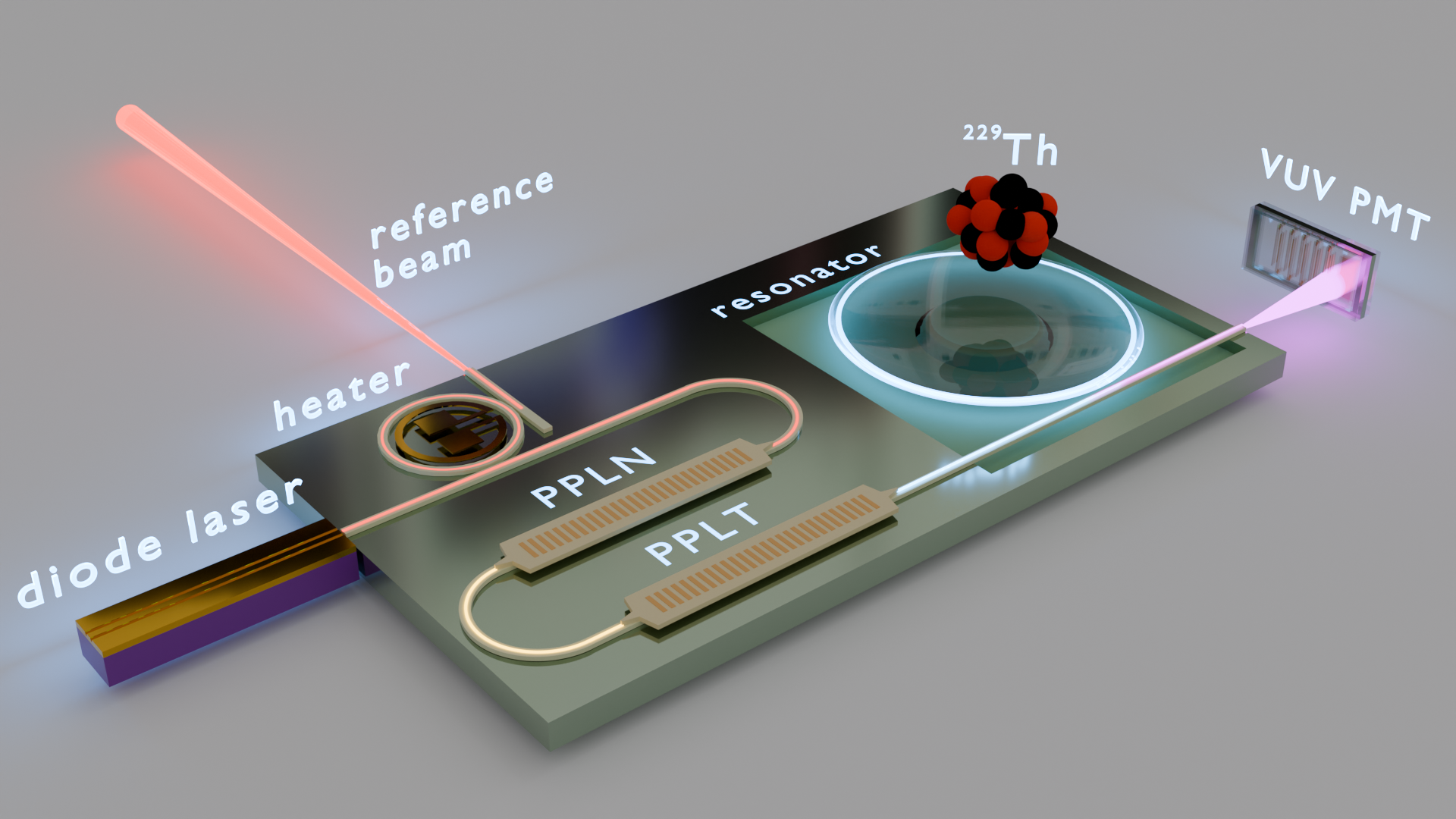
As part of a large Europe-wide collaborative effort, we put forward the idea of introducing Th-229 into whispering gallery mode resonators - a well established high-Q nanophotonic platform. The long-term vision is to launch the field of nuclear nanophotonics and create the first integrated nuclear clock. This direction is now entering the experimental domain as the first Th-229-implanted MgF2 was demonstrated recently.
Research questions
- How can we properly model a nuclear ensemble coupled to a cavity?
- Which resonator design is the best for enhancing the Th-229 nuclear transition?
- What interesting dynamical features arise in the WGM resonator response due to the presence of thorium?
- How can we actually build a clock based on such a resonator?
- Can we make an active frequency standard instead of a conventional passive one by leveraging many-body QED effects such as superradiance?
Selected publications
- K. Mamian!, G. A. Kazakov, T. Schumm, and C. Roques-Carmes†, Collective cavity quantum electrodynamics in solid-state optical clocks, arXiv preprint, arXiv:2609.248 (2026) (Link to preprint)
- S. Kraemer*†, K. Mamian!*†, T. Bi, S. Fujii, J. de Haan, H. Babu, A. Claessens, R. Ferrer Garcia, F. Ivandikov, P. Van Duppen, A. Dragoun, C. E. Düllmann, C. Marquardt, U. Wahl, B. Kuyken, T. Schumm†, P. Del'Haye†, L. M. C. Pereira†, G. A. Kazakov†, K. Van Gasse†, and C. Roques-Carmes†, Toward nanophotonic platforms for solid-state 229Th nuclear clocks, arXiv preprint, arXiv:2604.20687 (2026) (Link to preprint)