Quantum and nonlinear optics at extreme wavelengths
Impact statement
Generally, our work in different areas entails quantum optics in nonlinear driven–dissipative systems, focusing on how vacuum fluctuations, spontaneous symmetry breaking, and intrinsic quantum randomness give rise to emergent optical behavior. Our work investigates how these effects can be harnessed, controlled, and amplified in nonlinear optical platforms to enable new functionalities at both fundamental and applied levels.
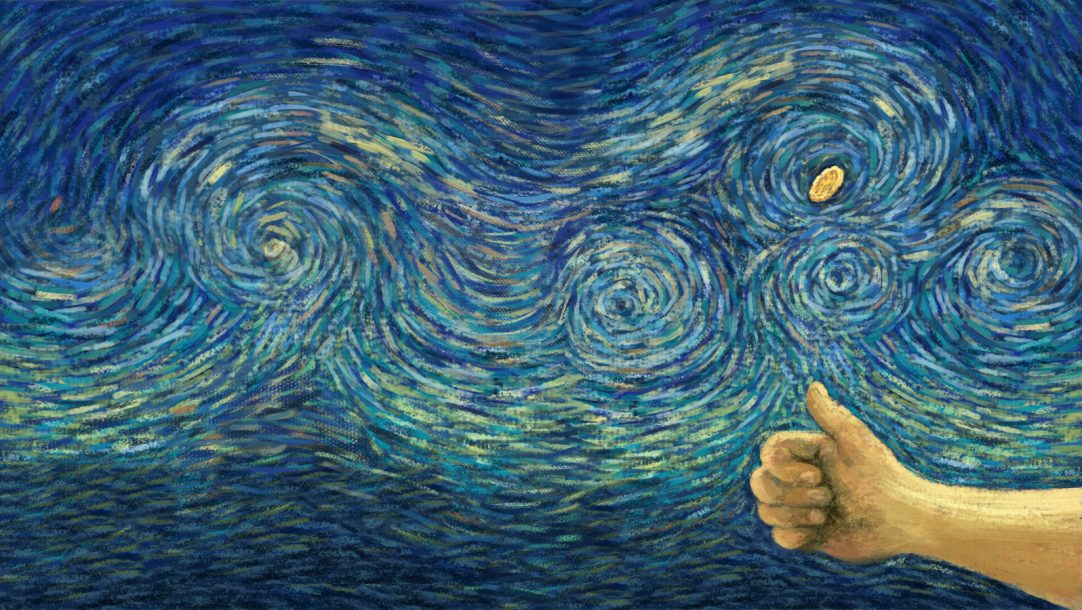
One important example is driven–dissipative nonlinear optical systems in which quantum vacuum fluctuations, multistability, and spontaneous symmetry breaking give rise to intrinsically stochastic dynamics. By introducing extremely weak bias fields—down to the sub-photon level—one can control probabilities of competing macroscopic states, enabling controllable sources of randomness and probabilistic behavior. Extensions to multimode and frequency-space systems further enrich this physics, leading to collective effects, non-reciprocal energy flow, enhanced frequency conversion, and emergent states such as chiral frequency combs, and providing a unifying framework connecting nonlinear dynamics, quantum optics, and photonic information processing.
We are particularly interested in pushing some of these concepts to extreme wavelengths, including the deep ultraviolet and X-ray regimes. This includes the development of nanophotonic resonators and cavity-enhanced platforms that enable cavity quantum electrodynamics with unconventional emitters, such as nuclear transitions. See our related research area on nanophotonics for integrated nuclear clocks.
Finally, we seek to connect these quantum and nonlinear optical phenomena with scintillation-based X-ray imaging, where individual optical photons can encode information about single X-ray events. In this context, extreme-wavelength quantum optics provides new tools to study non-equilibrium light emission, photon statistics, and information transfer across vast energy scales.
Research questions
- How do vacuum fluctuations and weak bias fields shape symmetry breaking, multistability, and stochastic dynamics in driven–dissipative nonlinear optical systems?
- Can biased OPOs and related platforms be engineered as controllable sources of quantum randomness for probabilistic computing, sensing, and tomography?
- How do multimode and frequency-space interactions modify nonlinear and quantum dynamics, and what new collective phenomena emerge in these regimes?
- What architectures enable cavity quantum electrodynamics at extreme wavelengths, including deep-UV and X-ray transitions, with solid-state or nuclear emitters?
- How can extreme-wavelength quantum optics be interfaced with scintillation-based X-ray detection to extract maximal information from single high-energy events?
Selected publications
- S. Choi*†, Y. Salamin*†, C. Roques-Carmes, J. Sloan, M. Horodynski, and M. Soljačić, Observing the dynamics of quantum states generated inside nonlinear optical cavities, Nature Communications, 16, 7576 (2025) (Link to article) (Link to preprint)
- A. Karnieli†, O. Tziperman, C. Roques-Carmes, and S. Fan, Decoherence-free many-body Hamiltonians in nonlinear waveguide quantum electrodynamics, Physical Review Research, 7, L012014 (2025) (Link to article) (Link to preprint)
- C. Roques-Carmes*†, Y. Salamin*†, J. Sloan, S. Choi, G. Velez, E. Koskas, N. Rivera, S. E. Kooi, J. D. Joannopoulos, and M. Soljačić, Biasing the quantum vacuum to control macroscopic probability distributions, Science, 6654, 381, 205-209 (2023) — Covered in the press by New Scientist, IEEE Spectrum, MIT Physics, Le Monde, and Le Figaro. For full list, see this page. (Link to article) (Link to preprint)